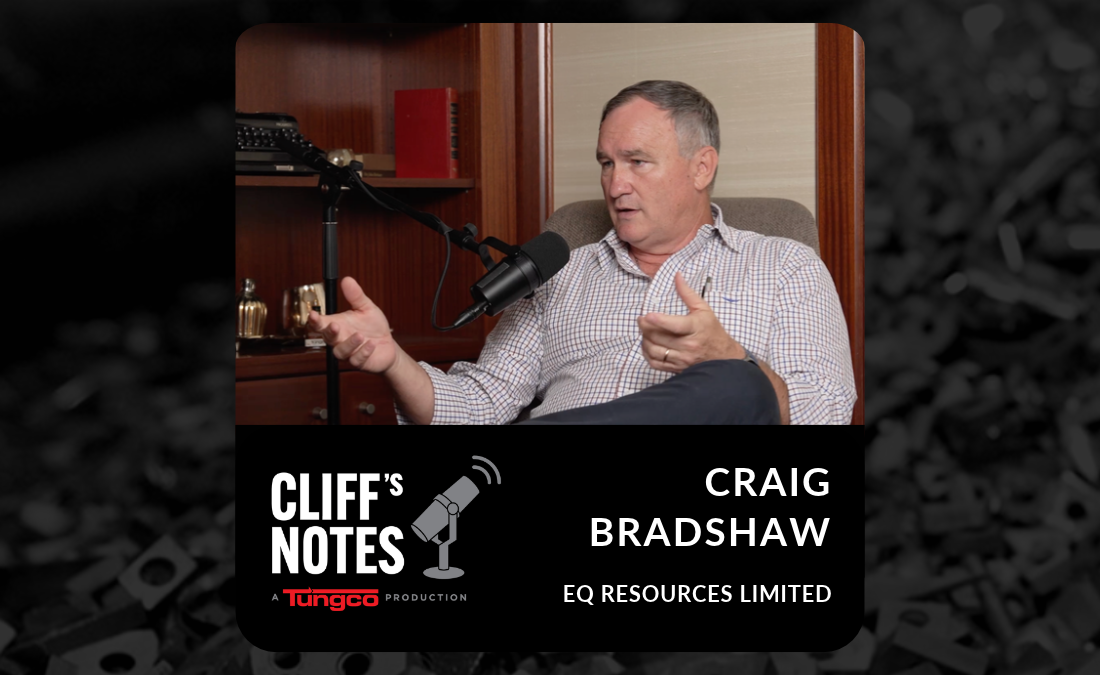
The Western tungsten industry is short on two things at once: mined material and the processing capacity to turn it into usable product. In Episode 408 of Cliff’s Notes, Tungco CEO Cliff Nance sits down with Craig Bradshaw, Managing Director of EQ Resources, recorded live at ITIA the day after EQ announced a joint venture with The Elmet Group and Blue Moon Metals to restart the Springer APT refinery in Nevada.
From Vietnam to EQ Resources
Craig and his three racehorse partners all started as mining graduates 34 years ago. After finishing in Vietnam, where his team helped build the Nui Phao mine and its APT refinery, Craig planned to retire, watch cattle eat grass, and race horses. That lasted about four or five months before EQ Resources called. He liked EQ’s assets and its people, so he came back to help the company work through its challenges. Today his niece runs the farm and sends him weekly videos so he can see his cattle.
Getting Two Tungsten Mines Up the Curve
EQ Resources operates Mount Carbine, a wolframite ore body in North Queensland, Australia, and Barruecopardo, a scheelite ore body in Spain. Both produce a 50% WO3 concentrate. Craig says EQ spent years short on capital, which led to short-term decisions and added risk. Over the last 12 months, the company removed liquidity and solvency risks, addressed governance issues, and refocused on mining fundamentals: geology, grade control drilling, blasting, processing, and maintenance.
- Barruecopardo hit record production in August.
- A new crushing and sorting circuit at Mount Carbine will double crushing from 1 million to 2 million tonnes and is due to be operational by March 2027.
- Combined, EQ expects to move from roughly 1,000 to 1,200 tonnes of WO3 in concentrate a year to a run rate of about 3,800 to 3,850 tonnes from October 2027.
- Only 23% of the resource had been drilled out to reserve status, so EQ is drilling at both sites to extend mine life and mine multiple faces, which lowers risk and gives customers consistent supply.
The Springer APT Joint Venture
Under the new joint venture, Elmet holds 70%, Blue Moon 20%, and EQ Resources 10%. The venture plans to restart the Springer APT refinery in Imlay, Nevada, originally built by Utah Mining under GE in 1982. Craig notes that the U.S. Department of War is supporting the effort with $450 million through Elmet. A year ago, EQ was chasing money; today it can fund its own developments, but Craig says building an alternate supply chain in direct competition with China still needs that kind of support.
How the West Lost Tungsten Processing
Craig walks through the history. In the early 1980s, China needed hard currency and flooded the world with low-cost tungsten concentrates, putting Western producers out of business. China later banned concentrate exports and pushed buyers into intermediates, then banned intermediate exports and moved to compete in finished products. Craig doesn’t think much could have been done in 1982, but says China’s strategy became obvious through the 1990s and 2000s, laid out in its five-year plans and Made in China 2025. In his view, the West could have avoided a lot of pain by being smarter about 20 years ago.
Dumping, Antitrust, and Protecting New Supply
Craig points to Chinese companies selling tungsten rods and blanks into Western markets at the price of Western scrap, which he calls the absolute definition of dumping. He welcomes government efforts to support Western industry and cut red tape, but says governments also need to stop predatory practices from killing new supply before it gets off the ground.
Off the Clock: Racehorses on Grass
Craig has four horses and a fifth due soon, all bred by a consortium of four friends from mining. They race on the flat on grass, not dirt like the Kentucky Derby, and he waits to race them as three-year-olds so they can grow into themselves. Cliff shares how Tungco sponsored an event at Churchill Downs during Scrap Expo in Louisville, with the Tungco name across the big board.
Why This Matters for Tungsten Recyclers
- The West is short on both mined tungsten and midstream processing capacity, which makes every source of feed, including scrap, more strategic.
- New Western APT capacity like Springer is still years away, so recycling remains a critical part of supply.
- Chinese finished products priced at Western scrap levels are a direct threat to Western recyclers and manufacturers alike.
Frequently Asked Questions
What is the Springer tungsten joint venture? A joint venture between The Elmet Group (70%), Blue Moon Metals (20%), and EQ Resources (10%) to restart the Springer APT refinery in Imlay, Nevada, built under GE in 1982.
Why is there a tungsten shortage in the West? According to Craig Bradshaw, the West is short on both mined tungsten and processing capacity after decades of reliance on China, which now restricts exports of concentrates and intermediates.
How much tungsten will EQ Resources produce? EQ expects a combined run rate of about 3,800 to 3,850 tonnes of WO3 in concentrate a year from October 2027, across Mount Carbine in Australia and Barruecopardo in Spain.
Where does tungsten recycling fit? Recycled tungsten scrap is a key feed for the Western supply chain while new mining and APT capacity comes online. Tungco recovers tungsten and carbide from industrial scrap across North America.
About Tungco
Tungco is one of the largest tungsten and carbide recyclers in North America, based in Madisonville, Kentucky. Tungco recovers high-value materials from industrial wear parts, cutting tools, and end-of-life equipment.
About Cliff’s Notes
Cliff’s Notes is Tungco’s podcast hosted by CEO Cliff Nance, featuring conversations with leaders, builders, and operators across the industrial economy. New episodes drop regularly across YouTube, Spotify, Apple Podcasts, and Spreaker.