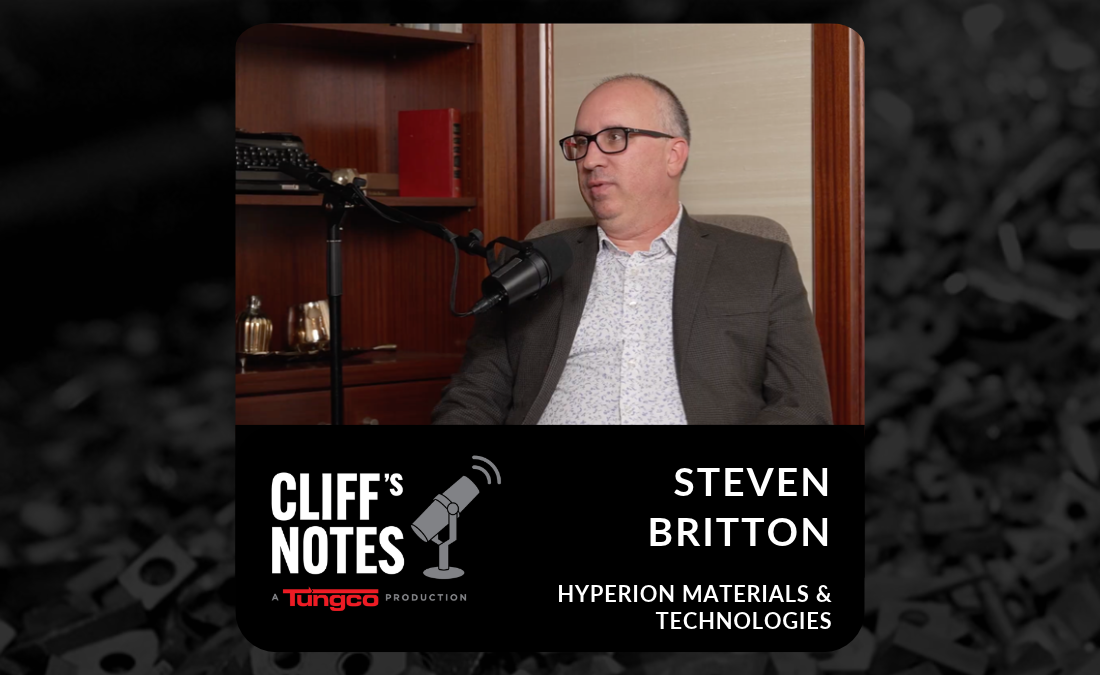
The tungsten industry has plenty of ore and scrap. What it is missing is the midstream capacity to process it. In Episode 407 of Cliff’s Notes, Tungco CEO Cliff Nance sits down with Steve Britton, SVP of Supply Chain at Hyperion Materials & Technologies, recorded live at ITIA, to talk about the gap in the middle of the tungsten supply chain and what it will take to fill it.
■ Watch Episode 407 on YouTube
From the Marine Corps to Tungsten
Steve’s path ran from high school to the Marine Corps, then college at 30, then a career in industrial manufacturing at Danaher businesses including Fluke, Qualitrol, and Tektronix. A carpool connection between
Hyperion CEO Ron Voigt and one of Steve’s former presidents led him to Hyperion about two and a half years ago. He came in with 20 to 25 years of supply chain experience but no tungsten background. In his world, APT meant “available to promise,” not ammonium paratungstate. Today his office is the airport: he runs two factories in France, Hyperion is headquartered in the Columbus, Ohio area, and home is Lake Gaston in Southern Virginia.
The Midstream Gap
Cliff recalls Ron Voigt describing his biggest fear years ago: the midsection of the supply chain evaporating with nothing to backfill it. That is where the industry sits today. Upstream feed, whether mined ore or scrap, does not help without midstream processing capacity. Steve says the Western world is in dire need of expanding that mid-level processing and does not expect China’s restrictions to change soon. He puts a softening in supply at least three years out, since new projects need time to start up and get qualified. For scale, he notes that a new 4,000-ton APT plant would cover only about 2% of global demand. Cliff compares China’s cut in APT exports to shutting off most of the world’s oil.
Building a Circular Supply Chain
Hyperion is investing in Asia with an acquisition that brings technology to convert scrap into WO3 and handle reduction in-house. Hyperion historically bought WC from large global producers. Now it can convert recycled and internal scrap back into usable product, moving further toward the source. The business is small today and will take time to scale, but Steve says the intellectual property is as valuable as the process itself. Hyperion had started down this path six to eight months before the February export announcement.
Where Tungsten Shows Up
Hyperion’s can tooling, made mainly in Barcelona, uses tungsten carbide punches to form beverage and food cans at tens of thousands per hour, because carbide lasts far longer than steel. Its rotary cutters cut diapers, bandages, and feminine products. And its carbide rod business, including the AFC acquisition in Germany, supplies chamfered, coolant-channel, and helical rods to toolmakers.
Why This Matters for Tungsten Recyclers
- Scrap and ore are only as valuable as the midstream capacity that can process them. • Expect tight midstream supply for at least three years while new Western projects get qualified. • Manufacturers like Hyperion are moving toward closed-loop supply, which makes recycling partnerships more strategic.
About Tungco
Tungco is one of the largest tungsten and carbide recyclers in North America, recovering high-value materials from industrial wear parts, cutting tools, and end-of-life equipment. Learn more at [tungco.com].
About Cliff’s Notes
Cliff’s Notes is Tungco’s podcast hosted by CEO Cliff Nance, featuring conversations with leaders, builders, and operators across the industrial economy. New episodes drop regularly across YouTube, Spotify, Apple Podcasts, and Spreaker.