On July 20, 2026, the President issued an executive order titled Securing America’s Defense Supply Chains and Ensuring Domestic Acquisition of Critical Materials. For defense contractors and their suppliers, it represents one of the more consequential shifts in materials compliance in recent memory.
The order does not introduce a new prohibition. What it does is remove the flexibility that made the existing prohibition survivable.
For anyone whose supply chain touches tungsten, that distinction matters a great deal.
What the Executive Order Actually Changes
The order enforces 10 U.S.C. 4872, the statute governing prohibited acquisition of certain materials from covered nations. That statute has been in place for years. The practical reality was that waivers made it porous.
Three changes close that gap.

1. Waivers Largely End on January 1, 2027
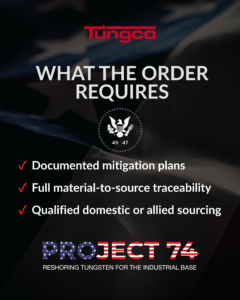
Beginning January 1, 2027, the Secretary of War and the Secretaries of the military departments cease issuing waivers under 10 U.S.C. 4872(c)(1) for the acquisition of covered materials, with one narrow exception.
That exception requires a prime contractor or subcontractor to submit a formal mitigation plan, accepted by the Secretary or a designee, that:
- Identifies the specific source of the non-compliant covered material
- Documents evidence of exhaustive efforts to acquire compliant material, or demonstrates that compliant material was unavailable at the time of acquisition
- Describes the steps that will remove the non-compliant material from the supply chain
- Establishes a strict projected timeline for complete implementation
The order also forecloses a common workaround. A contractor’s failure to qualify a domestic source does not constitute non-availability — unless that contractor can demonstrate active, adequately funded, and ongoing efforts to qualify one.
In other words, not having a domestic source is no longer a reason. It is now the problem to be solved.
2. Full Traceability to Raw Material Origin
Within 180 days, the Secretary is directed to develop policy requiring prime contractors and subcontractors at any tier to map and illuminate critical supply chains for covered acquisitions — from raw materials through to the end use products delivered.
The mechanism is an indentured Bill of Materials: documentation tracing all components, parts, equipment, software, and materials back to the origin of raw materials.
For most contractors, this is the heaviest lift in the order. Traceability at the component level is common. Traceability to the origin of the raw material inside the component is not.
3. Supplier Vetting and Mandatory Disclosure
Contractors will be required to establish written procedures to vet suppliers and subcontractors across three defined risk categories: financial risk, foreign ownership or control or influence, and manufacturing and supply risk.
Once vetting is complete, the timelines are short. Significant supply chain risks must be reported to the Department of War within 15 days. A written corrective action plan is due within 45 days. A closeout report follows completion.
Failure to qualify an alternative source where a supply chain includes an unreliable foreign supplier constitutes grounds for the Secretary to suspend or terminate task orders, decline to exercise contract options, or terminate the contract outright.
Why This Lands Hard on Tungsten
Tungsten occupies an unusual position. It is essential and it is concentrated.
The material is used in armor and munitions, aerospace components, and the cutting tools and wear parts that manufacture nearly everything else in the defense industrial base. It appears on the critical minerals lists published by the Department of Defense, the Department of Energy, and the U.S. Geological Survey.
And there is no active tungsten mine operating in the United States.
That combination is exactly what the executive order was written to address: a material the military cannot function without, sourced overwhelmingly from outside American control. A contractor who cannot document where their tungsten originated is not facing a paperwork problem. They are facing a qualification problem with a 2027 deadline attached.
What Compliance Requires in Practice
Reading the order against the operational reality, four capabilities separate a supplier who can support compliance from one who cannot.
Documented domestic or allied origin. Not where the material was last processed or last shipped from — where it originated. The indentured Bill of Materials requirement is specific on this point.
Chain-of-custody records. Continuous documentation following the material through every stage of processing, available for review rather than reconstructed on request.
Verifiable ownership structure. The order defines foreign ownership, control, or influence broadly, covering the power to direct or decide matters affecting management or operations, whether or not that power is exercised.
Qualification support. Because failure to qualify a domestic source is no longer an acceptable justification, contractors need suppliers who can actively participate in qualification rather than simply sell material.
How Project 74 Addresses the Standard
Project 74 is Tungco’s domestic tungsten initiative, operating from a facility in Madisonville, Kentucky. It recovers tungsten from domestic industrial scrap and processes it into the chemical feedstock that downstream manufacturers require.
The structure of that operation aligns with what the order now requires.
The material originates domestically. Project 74 recovers tungsten from scrap already circulating inside American industry — end-of-life cutting tools, drill bits, wear parts, and industrial tooling. There is no foreign mine in the chain because there is no mine in the chain at all.
Ownership is American. Tungco has been American-owned and American-operated since 1969.
Documentation exists as a matter of operation. Provenance tracking and chain-of-custody records are available, alongside third-party analytical verification of chemical products.
Federal contracting infrastructure is in place. Tungco maintains active registration in the System for Award Management and has existing federal contracting relationships.
Production is current. Project 74 is producing tungsten chemical products now. For contractors working against a January 2027 deadline, the difference between an operating source and a planned one is the entire question.
What Contractors Should Be Doing Now
The order sets January 1, 2027 as the date waivers substantially end. The regulatory work happens over the 180 days preceding it. That is a short runway for qualifying a new materials source.
A reasonable sequence:
- Identify tungsten content across your supply chain, including inside components sourced from subcontractors who may not have disclosed material origin.
- Trace each instance back to raw material origin. Where that trace breaks, you have found a compliance exposure.
- Assess whether current suppliers can produce documentation meeting the indentured Bill of Materials standard.
- Begin qualification of a domestic source now, rather than after a gap is identified. Qualification takes time, and the order requires demonstrable, funded, ongoing effort.
- Document the effort itself. Under the order, active qualification work is what distinguishes a defensible position from a disqualifying one.
The Larger Point
Every material entering the defense supply chain from an unverified source represents a vulnerability. That has been true for a long time. What changed on July 20, 2026 is that it became enforceable at the level of the raw material rather than the finished part.
For contractors accustomed to treating materials sourcing as a procurement detail, that is a significant adjustment. For suppliers who already built to this standard, it is a validation of an approach that was previously harder to justify commercially.
Tungco has recycled tungsten — and only tungsten — since 1969. The domestic focus was never a compliance strategy. It became one.
Evaluating domestic tungsten sourcing for a defense program?
Project 74 can provide documentation, production data, and facility access for contractors working through qualification requirements.
Learn more at project74.com or contact the team at 270-825-0000.
This article summarizes provisions of the executive order issued July 20, 2026. It is provided for general information and does not constitute legal or compliance advice. Contractors should consult qualified counsel regarding their specific obligations.