The Gateway Feedstock: Sodium Tungstate and the Future of Advanced Manufacturing
When most people think of tungsten, they think of heavy industrial tools — drill bits, cutting inserts, wear parts. And they’re not wrong. Tungsten’s hardness and density make it indispensable in industrial manufacturing.
But there’s a form of tungsten that almost no one outside the advanced chemical industry talks about — and it’s arguably the most important one.
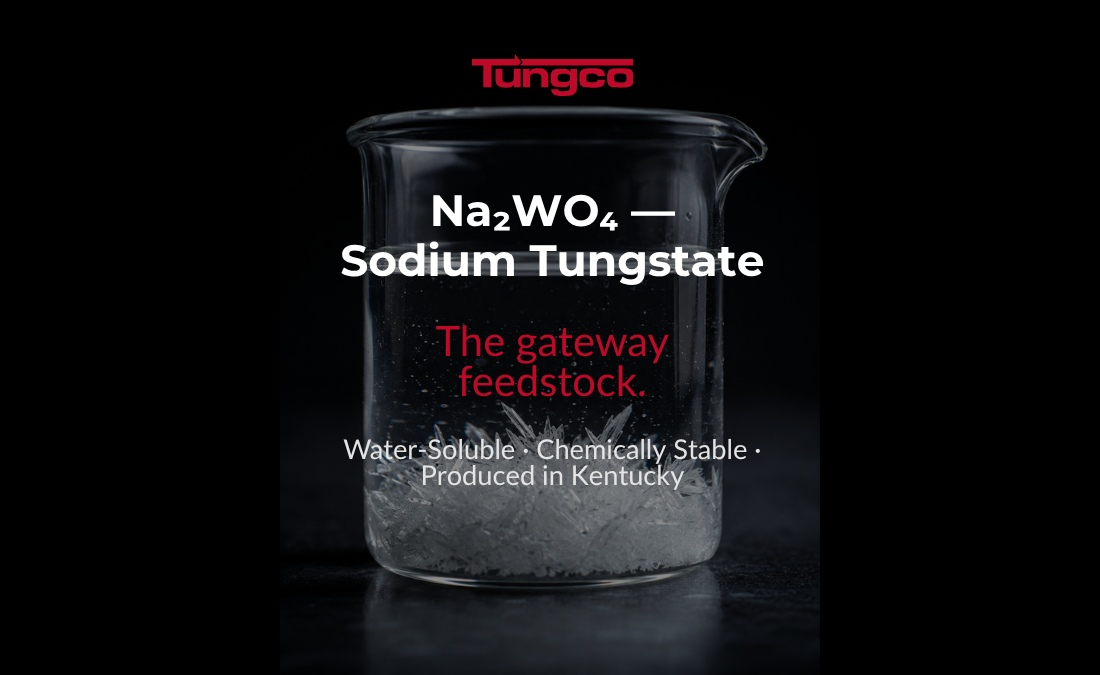
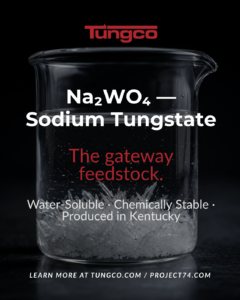
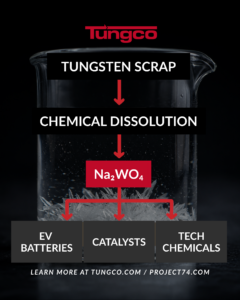
Sodium Tungstate (Na₂WO₄) is a water-soluble crystalline powder produced during the chemical dissolution of tungsten scrap or raw ore. It doesn’t look like a drill bit. It doesn’t look like scrap metal. It looks like a white crystalline salt.
And it is the universal gateway feedstock for the entire advanced tungsten chemical industry.
Why Sodium Tungstate Matters
Advanced manufacturers can’t simply melt down old tooling to build next-generation hardware. To power cutting-edge technology, tungsten must first be transformed into a highly purified, chemically stable form that downstream processors can work with.
Sodium Tungstate is that form. It serves as the foundation for:
- Ammonium Paratungstate (APT) — the industry’s benchmark tungsten intermediate and the single largest destination for Sodium Tungstate worldwide. APT is what tungsten is priced, traded, and specified against.
- Tungsten hard materials — the carbide inserts, end mills, wear parts, and mining and drilling components that keep American machine shops running.
- Cobalt-free EV battery materials — a critical input for next-generation lithium-ion and solid-state battery chemistry.
- Specialized industrial catalysts — used in petroleum refining, chemical processing, and advanced synthesis.
- Ultra-pure tech chemicals — precursors for semiconductor manufacturing and high-purity tungsten deposition.
From White Powder to Hard Metal: The Downstream Path
The route from Sodium Tungstate to a finished carbide tool is well established chemistry, and every step depends on the purity of what came before it:
Sodium Tungstate (Na₂WO₄) → Ammonium Paratungstate (APT) → tungsten oxide → tungsten metal powder → tungsten carbide powder → cemented carbide tooling, wear parts, and hard materials
That last step is where the story comes full circle. The worn insert a machine shop pulls off the line can be chemically recovered, converted to Sodium Tungstate, refined into APT, and returned to that same shop as a new insert. This is what closed-loop tungsten actually looks like in practice — not a slogan, but a supply chain that runs in a circle instead of a straight line from a foreign mine.
Without a reliable domestic source of Sodium Tungstate, American manufacturers in these sectors remain dependent on foreign supply chains — primarily Chinese — for one of their most critical inputs.
Project 74: Producing Sodium Tungstate Domestically
At Tungco’s Kentucky facility, Project 74 is changing that. Through urban mining — the chemical recycling of domestic industrial tungsten waste — Project 74 produces Sodium Tungstate from American scrap, delivering the exact chemical purity required by high-tech sectors and by APT refiners, right here in the United States.
No new mines required. No foreign supply chain dependencies. Just domestic waste streams converted into critical feedstock through proven chemistry.
Project 74 is SAM registered, third-party lab verified, and actively producing. If your organization is looking for a domestic source of Sodium Tungstate, an APT feedstock partner, or a closed-loop recycling program for tungsten scrap, we’d like to talk.
Learn more with Debbie B. West on her episode of Cliff’s Notes:
https://www.youtube.com/watch?v=XF39IYxc0xM&t=2s and at project74.com
📍 Madisonville, Kentucky · tungco.com · 270-825-0000