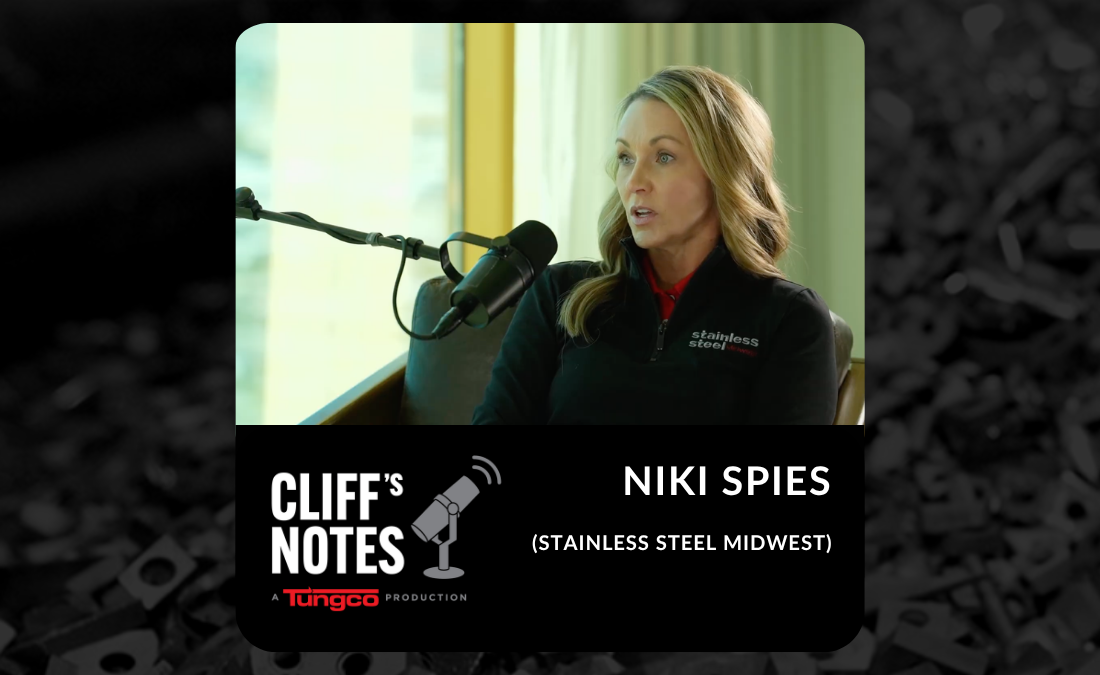
Stainless Steel Midwest moves roughly 16,000 tons of bulk steel every month. The entire global tungsten industry produces somewhere between 140,000 and 150,000 tons in a full year. In Episode 304 of Cliff’s Notes, Cliff sits down with Niki Spies — a 19-year stainless and nickel alloys veteran and longtime industry friend — to put those two worlds next to each other and see what they have in common.
■ Watch Episode 304 on YouTube
Two Metals Businesses, One Industry
Stainless Steel Midwest operates as a bulk stainless processor — buying all grades, creating chemistry-guaranteed blends, and delivering to mill spec. Their primary grades are 304, 316, 201, and 301. They also run an alloys division covering nickel alloys like Inconel and Hastelloy, and a specialty division that gets into air melt and vac quality material — which is where their business intersects with Tungco’s.
The volume comparison Cliff surfaces mid-conversation is striking: SSM’s 16,000 tons a month means they process the equivalent of the entire global tungsten supply in about 10 months — just one company, just stainless. Tungsten is a high-value, low-volume world. Stainless is the opposite. Both are driven by nickel.
Nickel Is the Engine — and It Touches Everything
Niki’s clearest insight in this episode is the chain reaction that runs from nickel pricing all the way to what a consumer pays for a refrigerator at the hardware store. Stainless steel — the dominant finish on premium appliances, widely used in housing, defense, food processing, and industrial applications — is fundamentally a nickel alloy. When nickel moves, stainless moves. When stainless moves, the cost of everything it touches moves with it.
Battery demand adds another layer. The conversation around nickel for EV batteries has cooled significantly from its peak — Niki notes the volume of discussion has dropped sharply compared to a year or two ago — but the underlying tension between battery-grade nickel demand and stainless-grade nickel supply hasn’t fully resolved.
Tariffs, Scrap, and What ReMA Got Right
On the tariff front, Niki’s situation is notably different from what Tungco and many other operators are navigating. Scrap crossing from Canada and Mexico is currently exempt from tariffs — a status that was briefly uncertain early in the current policy environment but has since been clarified. New production materials carry tariffs; scrap does not, at least for now.
Niki gives direct credit to ReMA for helping the industry stay ahead of that uncertainty — monthly sessions, policy briefings, and clear communication that let operators understand their exposure before it became a problem. Cliff echoes that sentiment; for Tungco, ReMA has been a similarly important resource.