You’ve driven past a road milling machine. You may have even been stuck behind one. But chances are you’ve never thought about the hundreds of tungsten carbide teeth spinning at 2,200 RPM on the drum inside it, chewing through asphalt 12 inches deep, consuming a fresh box of teeth every single day.
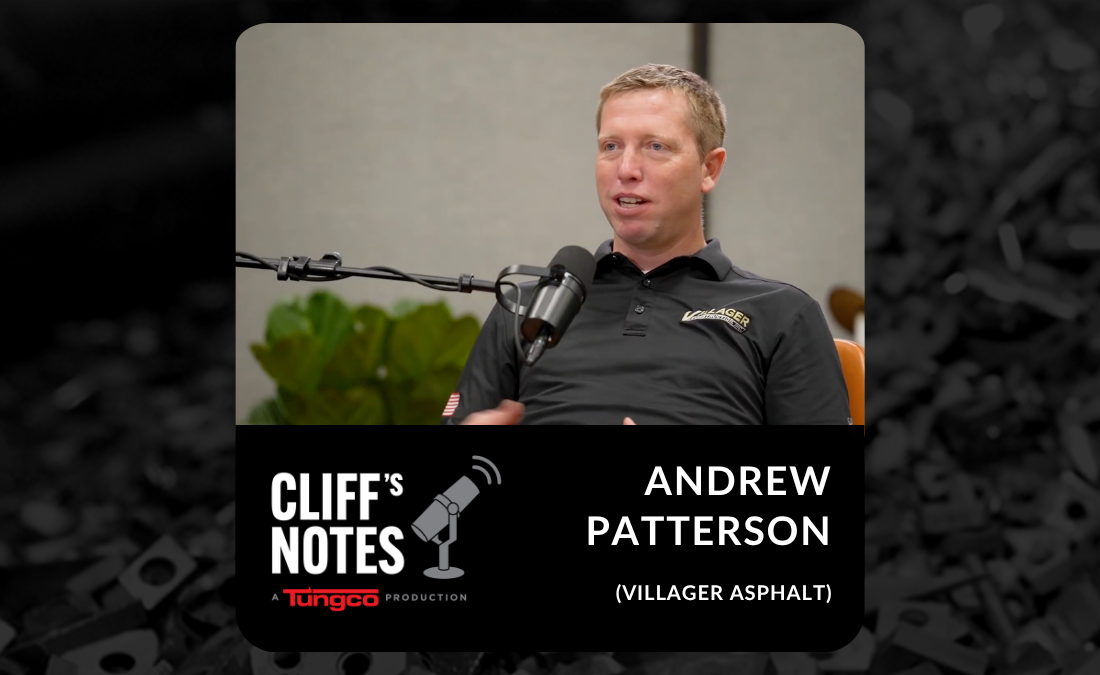
In Episode 207 of Cliff’s Notes, Tungco CEO Cliff Nance sits down with Andrew Patterson — milling department manager for Villager Asphalt, a large-scale operation running crews across South Carolina, North Carolina, Georgia, Alabama, Tennessee, and Florida — for one of the most technically detailed tungsten conversations the podcast has produced.
How Tungsten Performs — and Wears Out — in Asphalt Milling
Andrew walks through how a milling drum actually works: a cylinder up to 12 feet wide, lined with 150 to 160 tungsten-tipped teeth on an 8-foot drum, each tooth sitting in a holder welded to the drum and designed to rotate as it cuts. That rotation is the key to longevity. A tooth that stops spinning flat-spots immediately, wearing unevenly and accelerating failure.
Here’s the nuance that surprises even people close to the industry: the carbide tip is rarely the failure point. It’s the steel body it’s brazed onto that wears out first. Carbide outperforms the steel holding it — which is why the industry is constantly innovating on body design, washer systems, and holder geometry to protect the steel and keep the tooth rotating correctly.
Andrew also covers where else tungsten shows up on the machine: ejector paddles on the drum, and side plate wear skis — the carbide-bottomed runners that ride the road surface all day long, setting the depth reference point for the drum. Both are candidates for hard-facing to extend service life, and Andrew flags Tungco’s Cuda Grit line as something Villager is actively looking at.
PDC Tips, Buried Manholes, and the Trade-Offs Nobody Talks About
The episode gets into competitor tooth technology too — specifically PDC-tipped teeth, which use a polycrystalline diamond cap brazed onto a carbide body. On paper, they last virtually forever. In the field, one buried manhole or a drop on concrete and the braze pops, the diamond breaks, and an expensive tooth is gone. Andrew’s verdict: carbide is still where it’s at for the real-world abuse of daily milling operations.
Safety, Automation, and 20 Years of Change on the Milling Floor
Andrew has been in the milling industry for 20 years — long enough to remember running machines with hand cranks before digital grade controls existed. The safety improvements since then are significant: operators can now control grade from the cab, ground crews spend less time in traffic exposure, and some new machines are
shipping with full enclosed cabs. Automation is coming, and Andrew sees it — a remotely operated dozer running in Arizona while the operator sits in Las Vegas is a preview of where the industry is heading.
Tags
tungsten, tungsten carbide, asphalt milling, milling teeth, tungsten carbide wear parts, road construction, Villager Asphalt, Andrew Patterson, milling drum, carbide teeth, PDC tips, hard-facing, Cuda Grit, side plate wear skis, ejector paddles, Tungco, Cliff Nance, Cliff’s Notes podcast, carbide recycling, tungsten scrap, road milling machine