Every time you connect to the internet, stream a video, or use a data center-dependent service, there is a good chance a Vermeer horizontal directional drill put the fiber in the ground that made it possible. And somewhere on the front end of that drill — on the cutting heads and ground-engaging tools that chew through rock and soil — there is tungsten carbide hard-facing keeping the machine in operation.
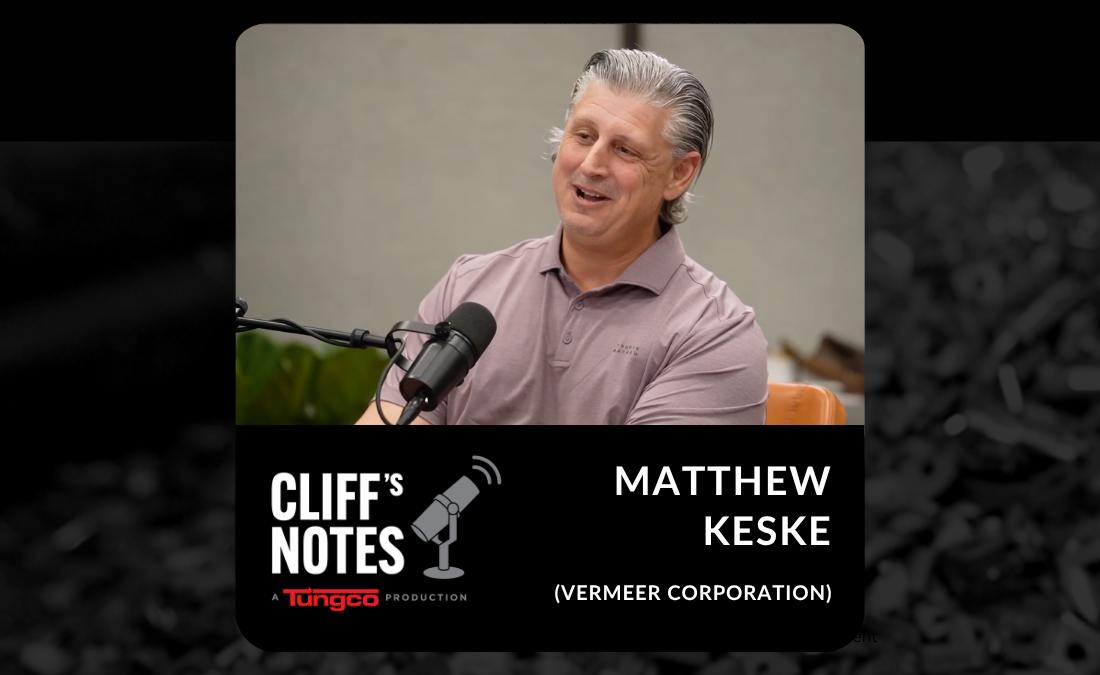
In Episode 204 of Cliff’s Notes, Tungco CEO Cliff Nance sits down with Matt Keske, commodity manager for Wear Tools at Vermeer Corporation, to talk about what it means to source and manage tungsten-bearing wear parts at scale, how global supply chain chaos is reshaping strategic partnerships, and why the AI infrastructure boom is quietly one of the best things to happen to underground drilling demand in years.
■ Watch Episode 204 on YouTube.
Who Is Vermeer — and Why It Matters to the Tungsten Supply Chain
Vermeer Corporation is headquartered in Pella, Iowa — a town of 10,000 people — and spans roughly 2 million square feet of manufacturing space, about a mile long and nearly half a mile wide. The company operates across agricultural, industrial, recycling, and forestry segments, with additional manufacturing in South Dakota, Western Iowa, the Netherlands for EMEA, outside Beijing, outside Sao Paulo, and the Eastern United States for their vacuum excavation (VAC) truck line.
Most people recognize Vermeer from the stump grinders and trenchers they see on the road. What’s less visible — literally — is the underground work: horizontal directional drills ranging from curb-to-house residential installs all the way up to 72-inch pipeline machines. These are the machines that put fiber, water, gas, and electrical infrastructure underground without tearing up streets. They’re why the internet works.
Matt Keske has spent nearly 30 years at Vermeer, starting in operations, moving through continuous improvement in the underground division, and ultimately landing in procurement as commodity manager for Wear Tools, OEM M&A partnerships, and hydraulics. His vantage point spans the full supply chain — from the raw materials going into wear parts to the strategic contracts that keep Vermeer’s customers running.
Tungsten Hard-Facing and the Wear Tools Connection
Wear tools are where Tungco and Vermeer’s relationship lives. The drill heads and ground-engaging tools at the front end of a Vermeer HDD machine take an enormous beating — and tungsten carbide hard-facing is what extends their working life in abrasive underground conditions.
Matt describes the underground drilling segment as one of Vermeer’s strongest growth areas in recent years, driven in part by government infrastructure funding releasing to contractors and in part by a more surprising demand signal: AI and data centers. Every new data center build requires fiber and utilities run underground. Every fiber run potentially needs a Vermeer drill. And every drill head needs wear protection. The connection between AI infrastructure spending and tungsten demand is not a stretch — it runs directly through the ground beneath the construction site.
Supply Chain Headwinds and the Value of Strategic Partnerships
Episode 204 hits the themes that are running through every conversation in the industrial metals space right now. Tungsten, copper, steel — nearly every commodity is facing significant headwinds from geopolitics, active conflicts, and a global supply chain that looks fundamentally different than it did 20 years ago.
Matt’s framing is direct: the answer to commodity chaos is not to shop on price. It’s to build partnerships that don’t collapse when the market turns. Vermeer has a 78-year track record of doing exactly that — rolling up sleeves, taking care of the customer, and working through the hard moments with suppliers and partners rather than abandoning them for the next best spot price.
That orientation is what Tungco hears from the best operators in the space. In volatile markets, a reliable partner who shows up consistently is worth more than an extra percentage point on the buy.
Vermeer’s Growth: 300,000 Square Feet and 300 New Team Members
Vermeer is not standing still. The company is expanding with a new 300,000-square-foot facility near Des Moines specifically to support tooling growth and access a broader talent pool — adding approximately 300 new team members to support that expansion. The VAC truck segment (vacuum excavation) is also identified as a growing frontier for the company, alongside continued strength in HDD and aftermarket parts.
Why This Matters for Tungsten Recyclers
- Wear tools from HDD machines are a consistent tungsten carbide scrap stream. Hard-faced drill heads and ground-engaging tools that come off Vermeer equipment carry meaningful recovery value when they reach end of life.
- Infrastructure spending is a leading indicator for wear tool demand — and by extension, for future carbide scrap volume. Government fiber and utility programs flowing to contractors means more drilling, more tool consumption, more eventual scrap.
- The AI and data center build cycle is a new and under-discussed demand signal for tungsten in wear applications. Tungco operates upstream of these trends; understanding them improves forecasting and sourcing decisions.
About Tungco
Tungco is one of the largest tungsten and carbide recyclers in North America, recovering high-value materials from industrial wear parts, cutting tools, drill tooling, and end-of-life equipment. Learn more at [tungco.com].
About Cliff’s Notes
Cliff’s Notes is Tungco’s podcast hosted by CEO Cliff Nance, featuring conversations with leaders, builders, and operators across the industrial economy. New episodes drop regularly across YouTube, Spotify, Apple Podcasts, and Spreaker.