Thermal spray coatings are in nearly every industry. You’ve just never heard of them. They’re inside the landing gear on commercial aircraft. They’re deep in power plants and mines. They’re in the glass mold that shaped the beer bottle on your counter and the ball valves keep pipelines sealed underground. And increasingly, they’re central to one of the most pressing conversations in the tungsten supply chain right now.
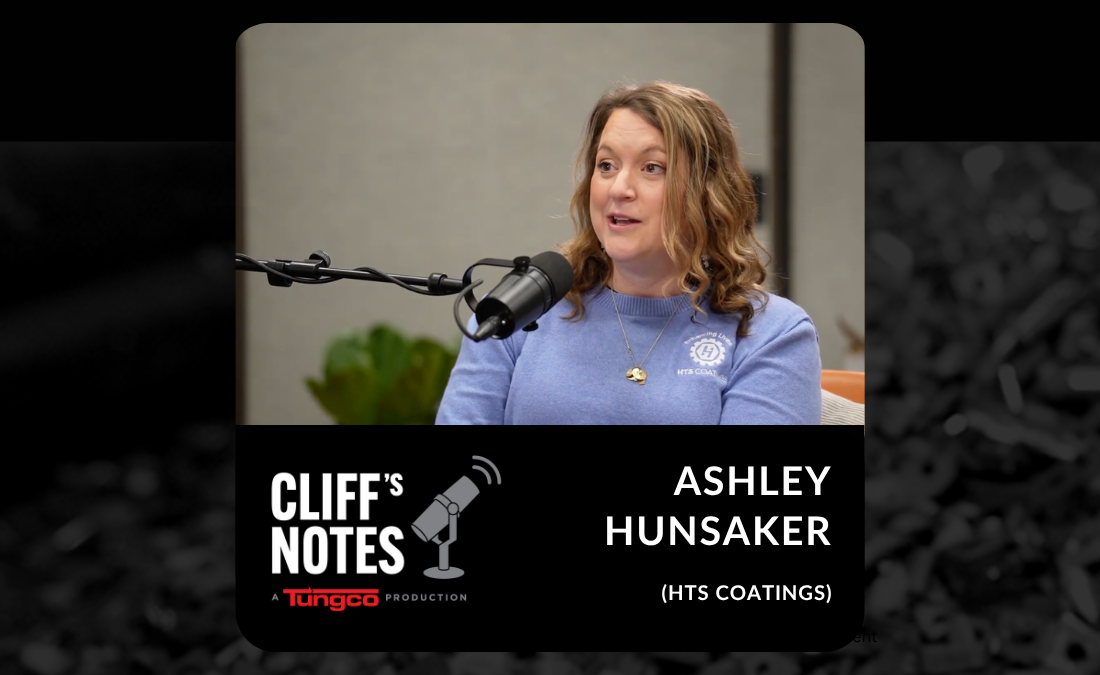
Ashley Hunsaker, co-founder and CEO of HTS Coatings, sits down with Tungco CEO Cliff Nance in Episode 203 of Cliff’s Notes to talk about all of it — and how a family in Madison, Illinois, turned a closing shop, an SBA loan, and eight months of pregnancy into a 10-year success story that’s now navigating one of the most volatile tungsten markets anyone has ever seen.
■ Watch Episode 203 on YouTube : https://youtu.be/_ct_1qtAV_0
The Origin Story: A Tiny House, a Closing Shop, and a Pregnant Co-Founder Who Said Yes
In 2015, Ashley’s husband Jason was working for St. Louis Metalizing — a thermal spray operation that the corporation decided to shut down when the land became worth more than the business. Jason came home and asked Ashley what she thought about starting their own company instead of building the dream house they’d been planning.
Ashley was eight months pregnant. They were living in 800 square feet with two kids, a dog, no garage, no basement, and one bathroom. She said yes.
Five banks turned them down for an SBA loan. A sixth called out of the blue, said she’d read the business plan, and closed the loan in 30 days. HTS Coatings officially launched in October 2015. Last year they celebrated their 10th anniversary.
The episode covers how Ashley — who thought she’d just handle the books — became the CEO after reading Traction and recognizing herself as the integrator Jason needed. It’s a story about complementary strengths, family business dynamics, and what it actually takes to scale a niche industrial operation from scratch.
What Thermal Spray Coatings Actually Do
HTS Coatings specializes in thermal spray — a process that propels molten metal out of a spray gun at roughly Mach 2 to build up a protective coating on industrial components. The goal is simple: reduce maintenance costs and increase production time.
What makes HTS technically distinctive is their investment in HVAF technology — High Velocity Air Fuel — which uses air instead of oxygen as the propellant. Because oxygen causes oxidation and brittleness in metals, switching to air produces a denser, more ductile coating. HTS is one of only a handful of companies in the United States operating three HVAF units, and those units are consistently fully booked.
Out of that platform, HTS developed a proprietary coating they call BTHC — a mixed-metal formulation designed as a direct alternative to hard chrome plating. Hard chrome, as widely used as it is, has an inherent problem: it’s microscopically cracked. Moisture and air work through those cracks to the substrate beneath. BTHC achieves near-zero porosity — Ashley describes it as essentially sealed — and has passed a 1,000-hour salt fog test with no rust blooms. It performs better than chrome and is more environmentally compatible.
Tungsten, Pricing, and the Critical Raw Materials Cold War
Tungsten is HTS Coatings’ premium coating material — and right now, it’s their biggest challenge. As Cliff and Ashley discuss, tungsten pricing is at historic highs, moving upward daily, with Western powder manufacturers sold out through the end of 2026.
Ashley’s read on the situation is direct: she doesn’t expect a return to normal pricing. Her working theory — one she articulates clearly in the episode — is that the world is in a critical raw materials cold war. China controls the majority of tungsten concentrates in the ground and has recognized that leverage. As long as Chinese export quotas remain in place, the supply picture doesn’t change.
For HTS, that means two things. First, developing tungsten alternatives — mixing metals to find formulations that perform comparably at lower cost. Second, educating customers: some applications genuinely require tungsten and will pay whatever it takes. Others have been defaulting to the premium coating out of habit, and Ashley’s team can help them right-size the spec. The concern she flags for the long term is the ‘good enough’ category — the risk that price pressure pushes customers toward steel-heavy alternatives with trace tungsten, the way it’s already happening in cutting tools and drills.
Why This Matters for Tungsten Recyclers
The conversation between Cliff and Ashley maps directly to Tungco’s position in the supply chain. Understanding how tungsten is used — in thermal spray coatings, in hard chrome alternatives, in aerospace landing gear and industrial hydraulics — is exactly what makes Tungco a better buyer and a smarter recycling partner.
- Thermal spray shops are a tungsten scrap stream. Used powder, off-spec material, and spent tooling from coating operations carry real recovery value.
- The push toward alternatives is a supply signal. When operators like HTS begin developing tungsten substitutes, it reflects broader demand dynamics worth tracking.
- Relationship buyers win in tight markets. Ashley’s comments on trust and long-term partnerships echo what Tungco hears from suppliers across the board right now.
About Tungco
Tungco is one of the largest tungsten and carbide recyclers in North America, recovering high-value materials from industrial wear parts, cutting tools, thermal spray operations, and end-of-life equipment. Learn more at [tungco.com].
About Cliff’s Notes
Cliff’s Notes is Tungco’s podcast hosted by CEO Cliff Nance, featuring conversations with leaders, builders, and operators across the industrial economy. New episodes drop regularly across YouTube, Spotify, Apple Podcasts, and Spreaker.