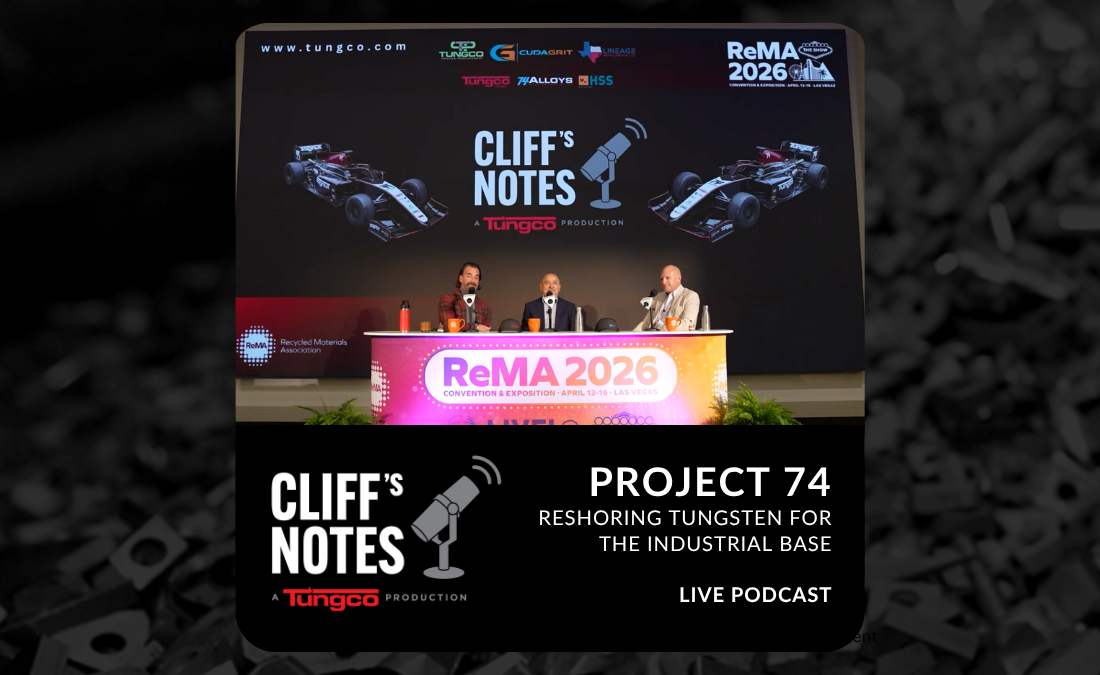
Tungco, the global leader in the tungsten industry, officially announced Project 74 live at ReMA 2026 in Las Vegas — a landmark milestone for the American tungsten supply chain. Captured as a special edition of the Cliff’s Notes podcast hosted by Tungco CEO Cliff Nance, this episode documents the launch of a strategic three-way partnership between Tungco, The Chem-Met Company, and Syram Corporation under Tungco’s Urban Mining Initiative (UMI). Project 74 is designed to convert domestic tungsten scrap into sodium tungstate, the critical chemical intermediate at the heart of tungsten metals production and tungsten recycling in the United States. This is not a pilot program or a future roadmap — Project 74 is operational, actively producing, and built for the long term. Learn more at www.tungco.com.
Why Tungsten Prices Are Surging — and What It Means for American Industry
Tungsten, element 74 on the periodic table and one of the densest and hardest metals on earth, has experienced one of the most dramatic price surges of any critical mineral in recent memory — rising five times in value over just eight months. China currently controls 70–80% of the global tungsten supply and has enacted significant export restrictions, cutting off access to the majority of the world’s primary tungsten for U.S. manufacturers. With no active tungsten mines operating in the United States and limited domestic processing capacity for tungsten scrap and tungsten recycling, American industry has been forced to ship strategic tungsten units abroad — often receiving only a fraction back as processed material. The result is a critical minerals supply chain under historic pressure, with downstream effects reaching tool steel manufacturers, defense contractors, semiconductor producers, and construction equipment suppliers across the country. Understanding tungsten’s role in the American industrial base has never been more urgent.
What Project 74 Does: Tungsten Scrap Recycling and Sodium Tungstate Production
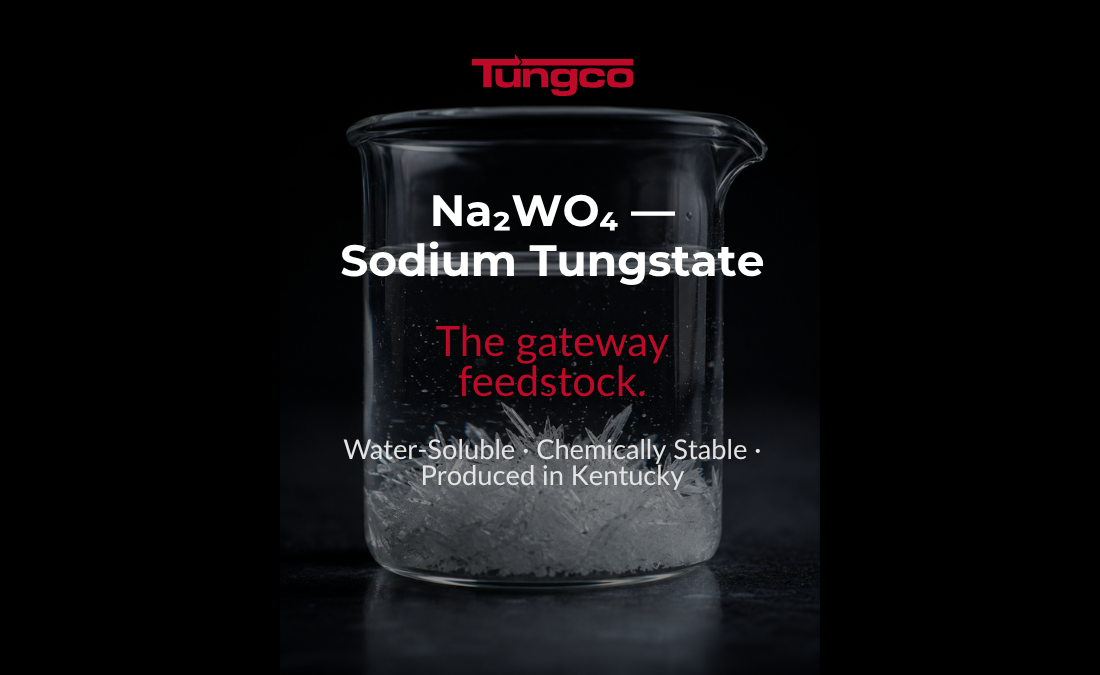
Project 74 by Tungco addresses one of the most pressing gaps in the American tungsten supply chain: the lack of domestic processing capacity to convert tungsten scrap into usable tungsten chemicals. The initiative collects domestic industrial tungsten scrap — material that would otherwise be exported — and processes it into sodium tungstate (Na₂WO₄), the crystalline white chemical intermediate that nearly 100% of all tungsten products must pass through before becoming a finished metal part. Sodium tungstate sits at the front end of the tungsten value chain: scrap becomes sodium tungstate, which becomes tungsten trioxide (WO₃), which becomes tungsten powder, which becomes finished tungsten metal and tungsten carbide products. Tungsten carbide is used in tool steels, cutting tools, mining equipment, construction machinery, and defense applications including armor-penetrating projectiles and drone components. Tungsten is also essential to AI chip manufacturing, semiconductor production, and radiation shielding in medical and security equipment. By building out U.S. sodium tungstate production capacity using domestic tungsten scrap and tungsten recycling streams, Project 74 closes the circular economy loop entirely within American borders — reducing dependence on Chinese tungsten, supporting the refractory metals industry, and strengthening U.S. critical mineral supply chain resilience.
The Case for Tungsten Reshoring: Critical Minerals, Scrap Processing, and U.S. Supply Chain Independence
One of the defining challenges explored in this Cliff’s Notes episode is what true tungsten reshoring requires — and why a scrap export ban alone would not solve the problem. The United States currently lacks the domestic processing infrastructure to handle even its high-quality tungsten scrap, meaning that without expanded capacity, restricting exports would simply strand material rather than strengthen supply. Project 74 is Tungco’s direct answer to that infrastructure gap. By expanding domestic sodium tungstate production using tungsten scrap already present inside the United States, Project 74 enables American tungsten recycling at scale — supplying existing U.S. tungsten producers, supporting tungsten chemical manufacturers, and building the foundation for genuine critical mineral independence. The episode also addresses the regulatory environment surrounding tungsten mining and metals processing in the U.S., the role of deregulation in accelerating critical mineral production, and the strategic importance of initiatives like Project 74 for industries ranging from aerospace and defense to construction, agriculture, and advanced manufacturing. For metals industry professionals, scrap dealers, recyclers, and critical minerals investors, this conversation is essential listening.
Tungco and the Future of the American Tungsten Industry
Tungco has been an established force in the global tungsten industry for over 55 years, operating across tungsten scrap sourcing, tungsten chemicals, and tungsten metals supply under brands including 74 Alloys, CudaGrit, Lineage Metallurgical, and Tungco GmbH. Project 74 represents the next chapter — a vertically integrated urban mining initiative that brings tungsten scrap recycling, sodium tungstate production, and domestic tungsten supply chain development under one strategic umbrella. With tungsten demand projected to grow at a CAGR of 5–8% over the next five to six years, driven by defense spending, drone manufacturing, AI infrastructure, semiconductor fabrication, and solar panel production, the timing of Project 74 is not incidental — it is essential. Tungco CEO Cliff Nance, alongside partners Victor of The Chem-Met Company and Furkhat of Syram Corporation, is building the model for what American critical mineral self-sufficiency looks like in practice: using existing domestic resources, expanding processing capability, and supplying U.S. industry without dependence on foreign supply chains. To learn more about Tungco, Project 74, and the Urban Mining Initiative, visit: