There’s a version of a tungsten-laden ground-engaging tool that looks incredible in a marketing photo — covered in carbide, straight out of a gladiator movie. And then there’s the version that actually performs. In today’s tungsten pricing environment, the gap between those two things has never mattered more.
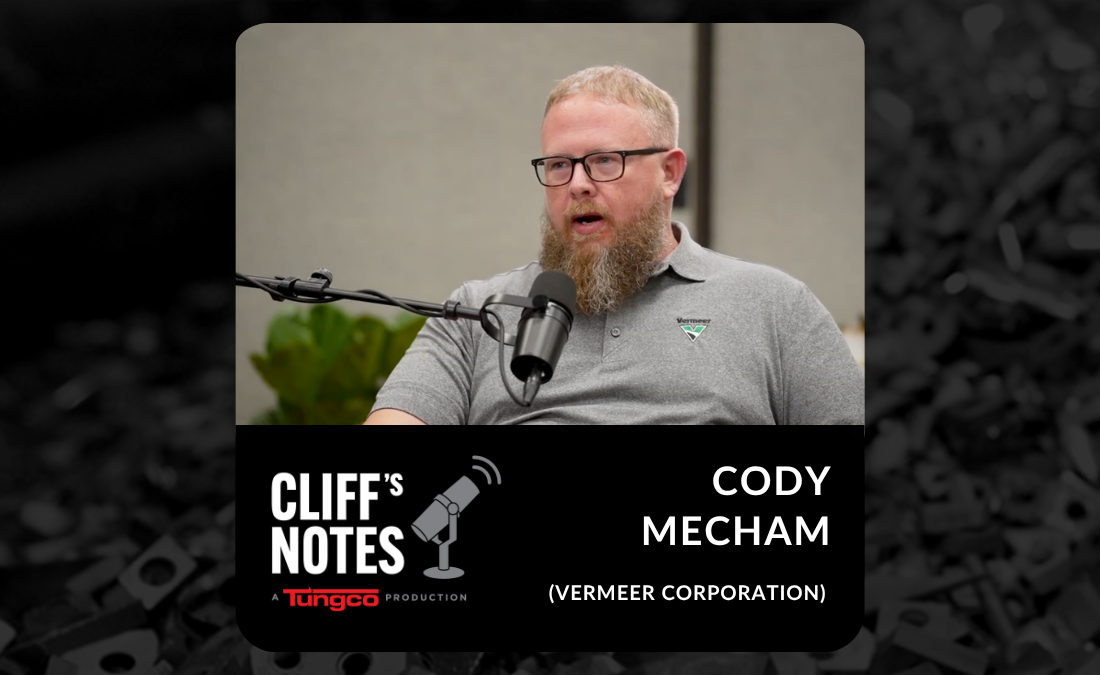
In Episode 208 of Cliff’s Notes, Tungco CEO Cliff Nance sits down with Cody Mecham — cutting edge product manager at Vermeer Corporation — to talk about how one of the world’s most diversified heavy equipment manufacturers is thinking about tungsten right now: not abandoning it, but engineering it with more precision than ever.
■ Watch Episode 208 on YouTube:
The Tip of the Spear
Cody’s role covers everything at Vermeer that cuts, digs, or chops — HDD tooling for infrastructure and pipeline, surface mining, wood waste recycling, and vacuum excavation. His framing is simple: Vermeer sells the machine, but the cutting edge team’s job is to sell the second and third machine. That only happens if the tooling performs. Tungsten is how they make it perform.
What most people underestimate, Cody says, is how abrasive even beautiful Iowa topsoil can be at high RPM. Put hardened steel into that environment at a thousand horsepower and pull it out an hour later — you’ll be asking where the steel went. That’s the problem tungsten solves, and why it’s been the material of choice across Vermeer’s wear-intensive product lines.
Precision Over Volume: The New Tungsten Design Philosophy
With tungsten prices where they are, Vermeer is scrutinizing every placement decision. Cody is direct: there’s no plan to move away from tungsten — it’s too good at what it does and too well understood across the supply chain. But there is a meaningful difference between putting tungsten everywhere it looks impressive and putting it exactly where the wear data says it needs to be.
That means switching some applications from tungsten carbide buttons to carbide grit inlay in the weld puddle — different form factors that can achieve comparable performance at a better price point. It means watching the markets every day. And it means accepting that the current environment, painful as it is, is going to drive innovation.
Cody’s take on PCD as an alternative is clear-eyed: it’s a different screwdriver, not a replacement. Tungsten and PCD don’t cross over cleanly — each has applications where the other simply doesn’t work as well. The answer isn’t to abandon one for the other; it’s to understand the blend.